Total Pageviews

Saturday, June 24, 2017

Game Design Post Mortem

The following is a Post Mortem of my time as a Game Design intern while attending the Game Design Master's program at Full Sail University.


Post Mortem: The goal of this section is to reflect on your year and identify critical points of learning.

  In your reflection consider - What went right? What went wrong? Why did things go right or wrong? How did things go right or wrong? How did the important events you chose to focus on affect the overall experience?


     What is the final takeaway/newfound insight that you are leaving with?

Throughout my year in Capstone I faced several critical moments that would inform my decisions during the overall experience. However, I would like to talk about a single experience that really helped to inform the rest of my time at Full Sail University.
As a game design intern, my role was to help student teams flesh out their design by helping to implement various aspects. As such, the relationship I had with teams was often tense. I was an outsider who, more often than not, was coming in during a late stage of development to help address design or usability concerns. One such experience with a team early on in my capstone would be critical moment of learning.
I was helping a team of developers who were trying to implement some unique design elements into their game. Their implementation left play-testers confused and overall progression in the game was not clear. My role was to help the developers understand the concerns of their target audience and recommend ways to help balance the design between the two parties. When it came time for me to make recommendations, I addressed the group in a casual way and ran through a bulleted list of suggestions. I got blank stares and no response. I considered that there were different methodologies to learning. Perhaps my dry, non-visual approach wasn’t easily conceptualized by the developers?
I tried again, this time emailing them a PDF with recommendations and step-by-step instructions. There was media imbedded throughout the file: images, videos, and gifs demonstrating a certain design element or possible implementation. This got a more positive reaction and I got actual feedback. I realized the audience I was working with simply needed a more visually-stimulating presentation. I made a final PowerPoint presentation, with limited text and more imbedded media. I used screengrabs of other games that the team was trying to emulate; showing them creative ways to implement and balance features. This moment taught me that everyone is different and I can’t make assumptions about how someone else might learn or conceptualize material.
There were a few things I did wrong in this situation. The first was making the assumption that the way I processed information would be similar to the rest of the team. Making a better effort to get a feel for each team member early on would have helped me. I also think it went wrong initially because I didn’t fully grasp their inspiration. Once I had a better understanding for what games had inspired their work, I had an easier time relating material to something familiar to them that also drives their passion.

I think the most important thing I did right was to keep trying until I could make a connection with the team. They could tell that I put in the effort and appreciated it. Going forward, we all worked better at communication to help achieve their goals. I also carried this on to the rest of the teams I worked with during my time in capstone. I strove to place communication above all else. Going into the industry, this experience will help me greatly as I will work at studios of a variety of different cultures and size. Being flexible and adaptable in how you communicate with your team is vital.

Tuesday, April 25, 2017

Star Wars: The Old Republic (A Critical Analysis)

This month, in Game Usability and Testing class, I was tasked with examining how game design elements were used. I decided to evaluate Star Wars: The Old Republic, created by BioWare in 2011. Check out my results below (go full-screen for maximum effect).

Monday, February 6, 2017

User Experience Feedback

A few months back, you might remember a post here about my participation in helping run a Student Game Expo (SGX). Since then, the monthly expo has grown exponentially and pulls in a good crowd every month. Though not actively running the SGX anymore, this month I did contribute by developing a way to get feedback from SGX attendees. One of the most valuable tools at a dev's disposal is the player. Understanding who your target audience is and what they think of your game could dramatically guide the direction of development. Thus I saw the SGX as an opportunity to gather feedback directly from the player, that I could then turn around and disseminate back to the teams.

With a thorough background in user experience, flow state, and video game heuristics, I set out to develop a feedback form that would provide the developers with valuable information. To this end, I pulled upon previous research I had conducted and used The Play Experience Scale: Development and Validation of a Measure of Play by Pavlas, Jentsch, Salas, Fiore, and Sims as a starting foundation. I also used Game Usability Heuristics for Evaluating and Designer Better Games by Heather Desurvire and Charlotte Wiberg to determine a sustainable formula for measuring heuristics.

Next, I developed the feedback form online using Google Forms and set it up for the SGX. I was there facilitating the feedback station to help the SGX attendees provide their thoughts. I also had a section on the form that would allow players to provide their own feedback directly to the developers. After the event, I consolidated the raw data collected and started charting and graphing the results. My ultimate goal was not to just dump the raw data to the team, as they might not have the same experience and understanding of video game UX. The information should be easy to read and understand by the teams, to ensure they can get the most out of it. After I was done, all that was left was providing the data to the teams. Below is a sample of how I presented the feedback to a team.


User-generated feedback should always play a part in informing the developers what people want from their product. Even just making the team aware of things they might have overlooked can be extremely helpful for teams that inadvertently suffer from tunnel-vision after months of working on a project. Got questions about obtaining UX feedback for your game? Comment below and I'll be glad to help!

Monday, December 5, 2016

Freemium Mobile Games, Presentation 1

Here is my first presentation in a series that will cover the content explored in Freemium Mobile Games: Design and Monetization, by Dimitar Draganov. This presentation will cover the current status quo of the mobile game industry.

Monday, November 14, 2016

Student Game Expo (September 2016)

In September of 2016, I was fortunate enough to be given the opportunity to help facilitate a Student Game Expo for current game development, undergraduate students. While I got to run and facilitate the SGX, I did have valuable assistance from fellow classmates Cardell King, Brian Vazquez, Justin Hentges, Jessica Lin, and Wade Martin. Additionally, there were a couple core faculty members that really did everything in their power to help us throw a great event. Nick Carver, in particular, was very passionate and motivational in helping us provide a unique, fun experience.

In addition to showcasing undergraduate game projects, the event included trivia (with awesome prizes), extreme video game music, food and drinks, photo opportunities with a polaroid camera, and lots of other fun activities. I was also able to secure a venue close to campus to host the event, Campus Cards and Games II. They were instrumental in coordinating with me to make sure we had the location and necessary furniture (tables and chairs) and really helped to build a solid relationship that helps both parties. Here is a flyer we used to help advertise the event online and around Orlando, FL.


The event had an amazing turnout with well over a hundred people coming in to experience the event. We got some great footage of the event to use as future promotional material (thanks to Marvin Welch for capturing and editing this video).


This was a great opportunity to practice running an event with many different attributes and aspects to cover. I was responsible for coordinating everything (with the help of my team) to ensure that the undergraduate students presenting had everything they could possibly need. These leadership and management skills will make a great addition to my skill set and I hope to utilize them again soon in the future.

Special thanks to Katherine Rybak for her volunteer work on this expo.

Wednesday, November 2, 2016

Mastery Journal Research Topic: Impact of Flow State on Monetization Design


            Several months of research, brainstorming, compiling, and editing have helped to present a finalized topic for my mastery thesis project. My thesis dwells in an established convergence of both Design and Monetization fields of video game development ("GDC 2017", 2016). With the rapid evolution seen over the past several years in the way games generate money, pugnacious realities can wreak havoc on a game for simply not utilizing the correct monetization structure (Rose, 2016). While monetization is one of the most vital aspects of game design, it is often the most overlooked in the industry today and not considered by many game designers (Rose, 2016). My thesis will aim to show the importance of monetization as a part of any game’s foundational design.

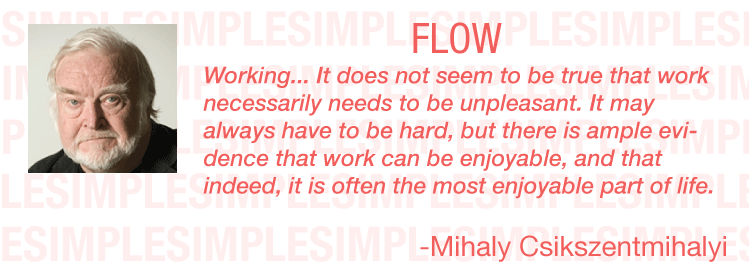
(via http://cdn.quotationof.com/images/mihaly-csikszentmihalyis-quotes-7.jpg)
          Flow, a mental state that elicits enjoyment accompanied by a precise and powerful focus, is the primary objective of all games and thus the most powerful apparatus in a designer’s toolbox (Chen, 2006). Since flow is an established element of the core purpose of a game’s design, it is logical to identify a relationship with monetization design. My thesis, in addition to providing data to support the importance of flow and monetization in design, will show how the two can work together in a mutually beneficial way. Being able to understand how these two aspects interact will give designers a way to reap the full potential of their creation. My proposal will show a how each monetization structure should be implemented with the flow aspects of game design. And since the video game industry generates over 16 billion dollars a year, there is limitless potential.


            While there are yet to be any major, established research in this specific area, there are several influential voices that handle these topics individually. Monetization, specifically in the mobile and social marketplaces, has been covered in-depth by Tim Fields of Kabam (Fields & Cotton, 2012). Other industry leaders such as Kate Flack, Ethan Levy, and Martin Koppel have also shared valuable information in regards to the impact of monetization on video games (Rose, 2016). Flow state in games has also been explored extensively by several industry voices. Mihaly Csikszentmihalyi, who first discovered Flow as a construct in the 1980’s and 1990’s, has spoken at length about the components of flow in games (Chen, 2006). Jenova Chen is also a notable voice who has explored flow in video game design, making large leaps forward in integrating the two together (Chen, 2006). I will use these voices and many more as I continue to build upon my thesis in the coming months.

_________________________________________________________________________________


References
Chen, J. (2006). Welcome to Flow in Games. Jenovachen.com. Retrieved 30 October 2016, from http://jenovachen.com/flowingames/introduction.htm
Fields, T. & Cotton, B. (2012). Virtual Goods. Gamasutra.com. Retrieved 31 October 2016, from http://www.gamasutra.com/view/feature/135067/virtual_goods__an_excerpt_from_.php
GDC 2017. (2016). Gdconf.com. Retrieved 28 October 2016, from http://www.gdconf.com/conference/

Rose, M. (2016). Understanding the realities of video game monetization. Gamasutra.com. Retrieved 30 October 2016, from http://www.gamasutra.com/view/news/205412/Understanding_the_realities_of_video_game_monetization.php

Wednesday, October 19, 2016

Flow State in Video Games

Mastery Journal Article Analysis: Flow State
Identification of Topic
     For my Mastery Program research assignment, I have chosen to investigate the area of game design. There are many facets to game design that present themselves as possible areas of research, but this paper will investigate flow state. Specifically, it aims to build upon the major influences of flow state: Seung-A Annie Jin, Marin Klasen, Rene Weber, and Mihaly Csikszentmihalyi.